


Do Home Renovations Increase Property Value?
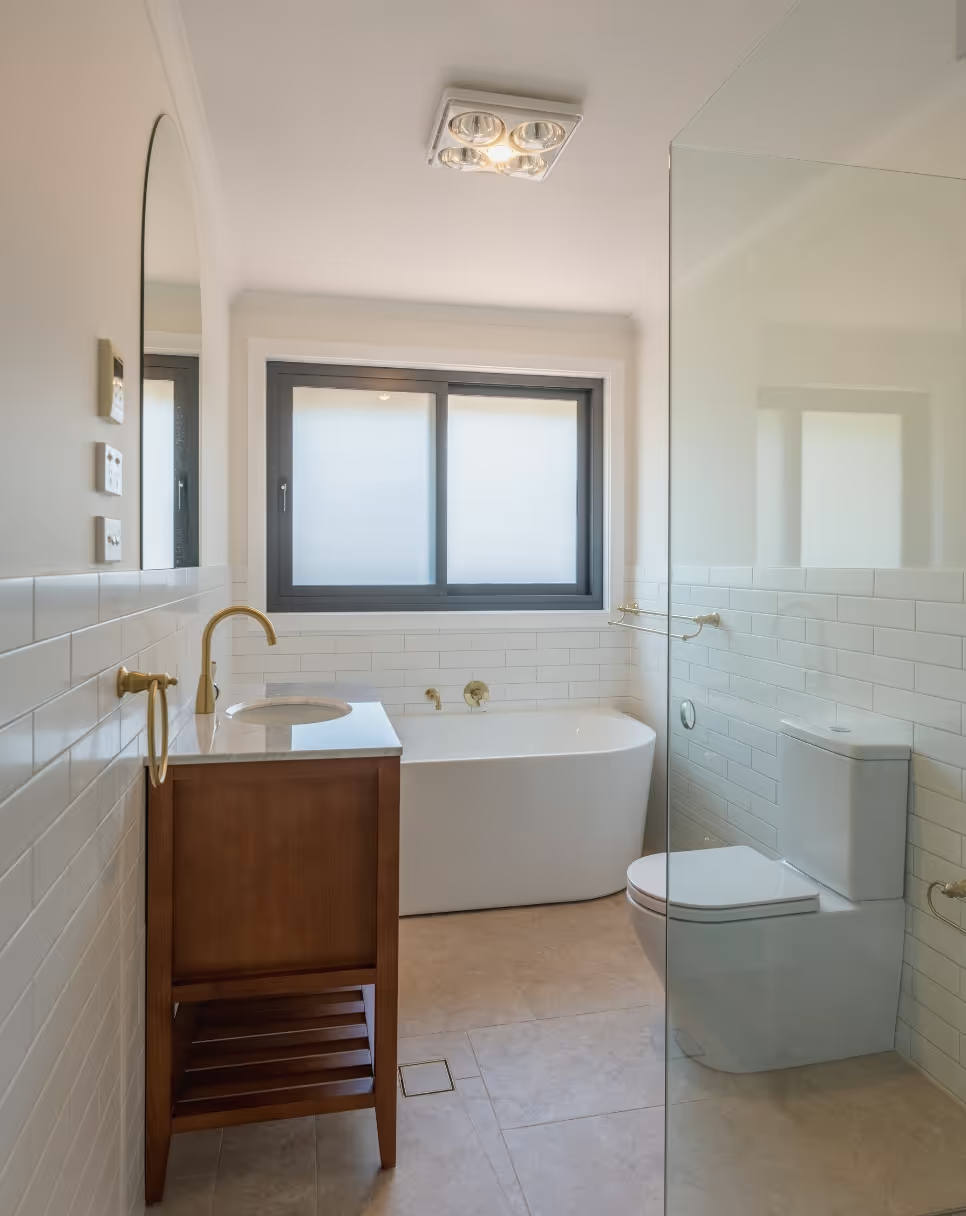
House renovations increase property value. A kitchen that returns 70 per cent of its cost in one suburb can return 40 per cent five kilometres away, because the ceiling on what buyers will pay is set by the street and the recent sales around it, not by your invoice.
That gap is where the money is made and lost. The useful question is not whether renovations add value, but which renovation, on which home, in which market. Below, we look into the real numbers, the projects that reliably lose money, and what a valuer is actually looking at when they walk through a renovated house.
The Short Answer. Yes, But It Depends
Renovation returns move on three things. The condition the home started in, how well the finished layout works, and what buyers in that suburb already expect for the price. A tired 1970s bathroom in an otherwise sound house is the strongest case for a renovation adding value, because you are closing a gap between your home and the comparable sales around it. A second renovation of a kitchen that was already good is the weakest. You are no longer fixing a shortfall, you are adding a preference.
Buyers do not price finishes line by line. They price the overall impression against everything else they inspected that Saturday, and they discount hard for anything that looks like work they will have to do themselves. That is why a mid-range renovation that leaves nothing obviously undone often beats a luxury one that ran out of budget before the laundry.
More Australians are choosing this path over moving. The national renovation market was worth more than $48 billion in 2025 and is tracking towards $51 billion by the end of 2026, with $14.3 billion of that in council-approved work (ABS and HIA figures). Stamp duty on a $4 million Eastern Suburbs purchase makes the comparison fairly blunt. Renovating the home you already own protects the equity you have built rather than handing a slice of it to the transaction.
Which Renovations Add The Most Value?
Wet areas lead, and they have for a decade. Industry figures put kitchen return on investment at roughly 60 to 80 per cent of cost and bathroom return at roughly 60 to 75 per cent. Valuation firm Duo Tax is more specific: a mid-range kitchen renovation around $35,000 lifting property value by about $20,000, a 57 per cent return, and a bathroom in the $15,000 to $30,000 band closer to 75 per cent. Treat these as indicative, not a quote for your house.
Kitchens and bathrooms
Wet areas outperform because they are the two rooms a buyer cannot mentally renovate on the spot. Everyone can imagine repainting a bedroom. Almost nobody wants to price a full kitchen or bathroom rebuild while standing in an open home, so they either discount heavily or walk.

Adding a bedroom or usable living space
An extension that adds a fourth bedroom or a genuine second living space is often the strongest performer of all, with industry estimates putting a well-executed bedroom addition above 75 per cent return. It only works when the suburb pays a real premium for the extra bedroom. Check what three and four-bedroom houses on comparable blocks have sold for in the last six months. If the gap is $400,000 and the extension costs $250,000, the case is obvious. If the gap is $150,000, it is not.
Layout, light and outdoor living
Some of the best value comes from work that does not add a square metre. Opening a closed-off kitchen into an open plan living area, moving a bathroom off the main hallway, adding storage where a family actually needs it, or bringing natural light into the middle of a long terrace. Covered outdoor living is the other quiet winner, commonly cited at 60 to 100 per cent return on investment. Energy efficiency work is the newer one. Insulation, glazing and solar now show up in buyer questions rather than just in running costs.
.jpg)
Where Renovations Lose Money
This is the half of the conversation most renovation articles skip, and it matters more than the winners' list. You are far more likely to lose money by choosing the wrong scope than the wrong tap ware.
Overcapitalising past the price ceiling
Overcapitalising means spending more on a renovation than the market will ever return, because the street has a price ceiling and your home now sits above it. A common rule of thumb is to keep a renovation budget to roughly 5 to 10 per cent of the property's current value, though that band widens for structural work and for suburbs with a high ceiling. Duo Tax uses a deliberately stark example: a $200,000 renovation on a $500,000 home can leave you $150,000 down. Overcapitalising is not about spending a lot. It is about spending a lot in the wrong postcode.
Highly personalised finishes
A bold colour in a wet area, a wine room where the third bedroom used to be, and custom joinery built around one piece of furniture. Each narrows the pool of buyers who will pay top dollar, and a smaller pool means a softer sale price. If resale is on the horizon, keep the permanent finishes neutral and put the personality into things that move out with you.
Pools, and removing a bedroom
A pool is the classic renovation worth doing for enjoyment and not for return. Industry estimates commonly put pool ROI at 20 to 35 per cent of cost, and for some buyers, the maintenance and fencing compliance actively counts against a property. Removing a bedroom to enlarge another room is the other reliable way to go backwards, because bedroom count filters your home in or out of a buyer's search before they ever see the photos.
.jpg)
Before you commit, look up what a renovated home like yours actually sold for on your street in the past six months. That number, minus your realistic buying price and your renovation cost, is your honest margin. Not the glossy figure in a magazine ROI table.
How Valuers Assess A Renovated Home
A valuer is not scoring your taste. They are answering one question for a lender: what would this property realistically sell for today? An appraisal works from comparable sales, meaning recent transactions of similar homes nearby, adjusted for land size, bedroom and bathroom count, condition and layout.
Comparable sales and functional condition
Because the valuation starts from comparable sales, a renovation only lifts it to the extent it moves your home into a better group of comparables. Turning a two-bathroom house into a three-bathroom house changes the comparison set. Replacing serviceable tiles with nicer tiles usually does not. Valuers record condition in broad bands, original, updated, renovated, and new, and the jump between bands is worth far more than incremental spend inside one.
Why quality workmanship beats showpiece extras
Sound structure, correct waterproofing, level floors, doors that close, and a layout that flows. These are what a valuer and a building inspector both look for, and poor workmanship is visible to them in ten minutes, even when it is invisible in photographs. A well-built mid-range renovation earns a better appraisal than an expensive one with obvious defects. That is the practical argument for paying for quality workmanship and a licensed builder rather than taking the cheapest quote.
Renovating For Value Or For Living
The maths changes completely depending on which one you are doing, and most people are honest about it only after the budget is set.
The Eastern Suburbs picture
Sydney's Eastern Suburbs sit near the top of the national market, with median house prices around $3.71 million in Randwick, $4.45 million in Bondi and $4.95 million in Coogee as at early 2026. A high suburb price ceiling changes the calculation: quality work that would clearly be overcapitalising in a $900,000 market can be entirely rational here, because buyers at that level expect it and price accordingly. It cuts the other way, too. Buyers paying those figures notice a cheap finish, and they discount for it more sharply than buyers further out.
When a forever home changes the maths
If you are staying for fifteen years, resale return is only one input and probably not the main one. Liveability is the return. A layout that suits how your family actually moves through the house, a kitchen that works when four people are in it, an extension that means nobody moves out when a third child arrives. In a forever home, that liveability pays out daily, and the eventual sale price is a secondary benefit. Just make the decision consciously rather than telling yourself a pool is an investment.
Getting advice before you commit
Two conversations are worth having before you spend anything. Ask a local agent what your home would sell for as-is and what it would sell for renovated, then have a builder price the scope properly, including the structural and compliance work that rarely appears in early estimates. The distance between those two answers is the actual decision, and it tells you how much of your equity the renovation is really putting at risk. Property values can fall as well as rise, and this is general information, not financial advice, so treat every figure here as a starting point.
Frequently Asked Questions
Which renovations add the most value in Australia?
Kitchens and bathrooms lead consistently, followed by adding a bedroom or a genuine second living space, where the suburb pays a premium for it. Layout changes that improve flow, storage, open plan living and natural light punch above their cost, and covered outdoor living is commonly cited at 60 to 100 per cent return on investment. Energy efficiency upgrades are increasingly raised by buyers.
What is overcapitalising and how do you avoid it?
Overcapitalising is spending more on a renovation than your suburb's price ceiling will ever return. Avoid it by checking recent comparable sales for renovated homes on your street before you set a budget, and by pricing the full scope, including structural and compliance work, rather than only the visible finishes.
Does adding a bedroom increase value?
Usually, and often strongly, with industry estimates putting a well-executed bedroom addition above 75 per cent return. The test is the gap between what three and four-bedroom homes on comparable blocks have sold for recently. If that gap comfortably exceeds the cost of the extension, the numbers work. Never create the bedroom by carving up an existing living space.
Do I need council approval for a renovation in the Eastern Suburbs?
Most extensions and any structural work need council approval, and a development application is standard for heritage-affected properties, which are common across the Eastern Suburbs. Some internal work qualifies as exempt or complying development. Altimo Homes manages the approvals process as part of the project, and a typical extension runs three to six months on site.
Thinking about a renovation or extension in Sydney's Eastern Suburbs? Get a free quote from Altimo Homes on 0478 782 571 or at admin@altimohomes.com.au, and we will price the full scope so you can see the real numbers before you commit.
About the Author
David, Owner, Altimo Homes
David is the owner of Altimo Homes, a family-run building company that has been delivering renovations, extensions, new builds and fit-outs across Sydney's Eastern Suburbs for over 10 years. He runs projects and client communication himself, which means he sees firsthand which renovation decisions hold their value at resale and which ones homeowners regret. He can be reached on 0478 782 571.